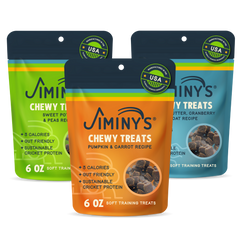


Our CEO Anne Carlson was recently featured in The New York Times discussing the future of sustainable pet nutrition. Here's what she had to say about making meaningful change, one bowl at a time.
When it comes to environmental impact, our pets might just be the unexpected heroes. In a recent New York Times article exploring the future of pet food, Jiminy's CEO Anne Carlson highlighted something remarkable: the unique opportunity that pet nutrition presents for creating immediate, lasting change.
Why Pet Food Matters More Than You Think
Unlike humans, who might eat dozens of different foods in a week, our dogs and cats are creatures of habit. They're perfectly content eating the same nutritious meal day after day. As Anne explained to the Times, "It's like flipping a switch. One day it's unsustainable, the next, it's sustainable."
This consistency is actually a superpower when it comes to environmental impact. While we might struggle to overhaul our own complex diets, switching our pets to sustainable nutrition can create immediate, measurable change.
The Truth About Consumer Motivation
Anne shared an honest insight from our years in the sustainable pet food space: "What we're learning is that people don't really react or buy based on sustainability." So what does motivate pet parents? The same things that have always mattered most—nutrition, taste, and their pet's wellbeing.
The beauty of insect-based protein is that it doesn't require pet parents to compromise on any of these priorities. Cricket protein delivers complete amino acid profiles, dogs love the taste, and the environmental benefits come as a bonus.
Dogs Don't Overthink It
Perhaps most importantly, as Anne noted, "The dogs are not going to overthink it." While we might spend months researching and agonizing over dietary changes for ourselves, our dogs are refreshingly straightforward. They care about taste, nutrition, and how the food makes them feel—and cricket-based nutrition excels on all these fronts.
The Bigger Picture
The New York Times article explored how both insect protein and lab-grown meat "have the potential to be far less damaging to the environment." At Jiminy's, we've seen firsthand how this potential translates into real impact when pet parents make the switch.
Every bag of Jiminy's represents a choice—for better nutrition, for environmental responsibility, and for a food system that works better for everyone. And the best part? Your dog will never know they're saving the world, one delicious meal at a time.
Read more in The New York Times.
https://www.nytimes.com/2025/07/03/science/pets-food-insects-lab-meat.html
Emily Anthes is a science reporter who writes Pet Theory, a column about our creature companions.
Frequently Asked Questions About Insect Protein in Pet Food and the NYT Feature
1. What is the main idea behind the New York Times article “Don’t Like Eating Insects? Your Pet Might”?
The article discusses how insect-based pet food — like that made by Jiminy’s — offers a more sustainable alternative to traditional meat proteins and points out that pets may readily accept these products even if humans feel squeamish about eating insects themselves.
2. Why was Jiminy’s featured in The New York Times?
Jiminy’s CEO Anne Carlson was interviewed to share insight on sustainable pet nutrition and how switching pets to insect protein can create measurable environmental benefits without compromising nutrition or taste.
3. Do dogs and cats like insect-based protein foods?
Yes — many pets are highly receptive to insect protein because it delivers complete amino acids and palatable nutrition, and pets don’t have the cultural “yuck factor” humans do about insects.
4. Why is insect protein considered sustainable for pet food?
Insect protein produces significantly less environmental impact than conventional livestock — requiring less land, water, and feed and emitting fewer greenhouse gases. This makes it an appealing climate-friendly choice when compared with beef or other traditional animal proteins.
5. How does feeding pets insect protein help the environment?
Because pets consume billions of pounds of meat annually, replacing even part of that diet with insect protein could substantially reduce natural resource use and greenhouse gas emissions associated with pet food production.
6. Are people generally open to eating insects themselves?
Many people in Western cultures remain hesitant to eat insects due to cultural norms and the “yuck factor,” even though studies show insect protein is nutritious and palatable. However, this hesitation doesn’t often translate to feeding insects to pets.
7. Does the article suggest insect protein is healthy for pets?
Yes — insect protein provides essential amino acids and is comparable to conventional animal proteins in nutritional quality, making it a viable and healthy ingredient for dog and cat diets.
8. What motivates pet owners to adopt sustainable pet food?
While many consumers are motivated by nutrition, taste, and pet wellbeing, sustainability is often an added bonus — not the primary reason — for choosing insect-based diets.
9. Are insect-based and lab-grown proteins both mentioned as sustainable options?
Yes — the NYT article explores both insect-based and lab-grown proteins as potential ways to reduce the environmental footprint of feeding pets, highlighting innovation in pet nutrition.
10. Can insect protein replace traditional meat entirely in pet foods?
Insect protein can be a nutrient-complete alternative and is already used in many formulations, but whether it fully replaces traditional meats depends on pet needs, formulation goals, and owner choice.